Two people need help with addiction. One types “rehab center near me” into Google at 2 AM. The other scrolls Instagram during lunch, feeling stressed and alone. Both need treatment. But they’re in completely different places mentally.
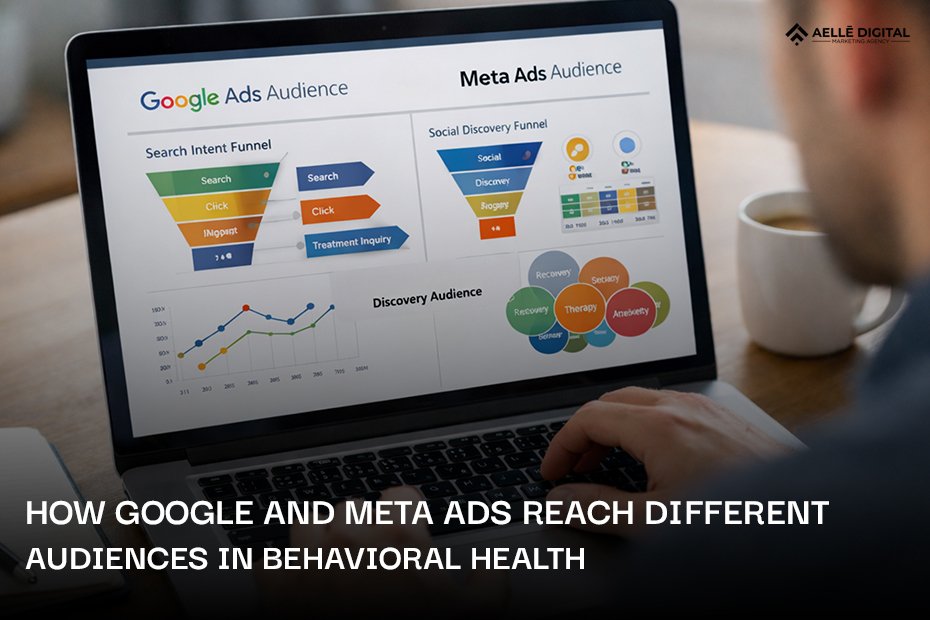
This is the challenge of behavioral health marketing. You have two groups of people. One group knows they need help and searches for it. The other group doesn’t realize help exists yet. Google and Meta (Facebook and Instagram) reach these two groups in totally different ways.
Google finds people who type their problems into a search bar. Meta finds people based on their age, interests, and behavior online. One costs more but brings patients ready to act now. The other costs less but requires more patience.
Here’s how both platforms work and why smart treatment centers use them together.
Key Takeaways
Google Ads target people actively searching for treatment right now with high intent to act, while Meta Ads reach people earlier based on their demographics and behavior before they’re ready to search. Google typically costs significantly more per click than Meta, but consistently produces higher-quality leads that are more likely to convert to admissions. The best behavioral health marketing uses both platforms together—Meta builds awareness, Google captures action.
| Platform | How It Works | Best For | Lead Quality |
| Google Ads | Targets active searches like “rehab near me” | Crisis services, immediate admissions, urgent care needs | High-intent leads ready to act now, higher conversion rates |
| Meta Ads | Targets based on age, location, interests, behavior | Brand awareness, family outreach, outpatient programs | Lower-intent leads needing nurturing, longer sales cycles |
| Combined Strategy | Meta builds awareness → Google captures action | Consistent admissions, long-term growth, full-funnel coverage | Higher overall patient volume and brand recognition |
Ready to build a marketing strategy that reaches patients at every stage? Aelle Digital helps treatment centers grow with proven Google and Meta ad campaigns.
Why Most People Don’t Search for Help Until It’s Urgent
Mental health and addiction come with heavy shame. People wait months or even years before they type “therapist near me” into Google. They tell themselves they can handle it alone. They worry about what others will think.
This delay creates a big problem for treatment centers. You can only reach people through Google after they decide to search. But what about all the people struggling right now who aren’t searching yet?
Here’s what happens in most cases:
- People deny they have a problem for weeks or months
- Family members notice something is wrong first
- The person hits a crisis point (job loss, DUI, health scare)
- Finally, they search for help on Google
By the time someone searches, they’re often desperate. This makes Google ads powerful but limited. You can only reach people who already know they need you.
The real opportunity is reaching people before the crisis happens. This is where your mental health marketing strategy needs to think bigger than search ads alone.
The Problem with Waiting for People to Search
Only a small number of people search for treatment each day. In most cities, maybe 50-100 people search for “drug rehab” or “therapist” daily. That’s your entire Google audience.
This creates three big problems:
Limited reach. You can only advertise to people actively searching. Once you reach all the searchers, you can’t grow anymore.
High competition. Every treatment center competes for the same small group of people. This drives costs up to $20, $30, even $50 per click.
Crisis-driven decisions. People searching in crisis mode often pick the first result. They may not be the best fit for your program.
Think of it this way. Google is like waiting for someone to walk into your building and ask for help. It works great when they show up. But you’re missing everyone who needs help but hasn’t walked through the door yet.
What if you could reach people before they hit crisis mode? What if you could help them see they have options before things get worse? This approach to rehab lead generation requires a different platform entirely.
Two Ways People Find Treatment Centers (And Why They’re Completely Different)
People find treatment centers through two paths. Path one is active searching. Someone types keywords into Google when they’re ready for help. Path two is passive discovery. Someone sees your ad while scrolling social media and thinks, “Maybe I should talk to someone.”
These paths require totally different marketing approaches.
The Active Path (Google)
- A person knows they need help
- They search for specific terms
- They want answers now
- They’re ready to call or book
- High urgency, high intent
The Passive Path (Meta)
- A person feels stressed or overwhelmed
- They scroll Facebook or Instagram
- Your ad catches their attention
- They learn about options
- Low urgency, building awareness
Both paths matter. Some people need immediate crisis care and will search for it. Others need ongoing support and don’t know where to start. Your addiction treatment marketing should reach both groups.
The key difference? Google captures demand that already exists. Meta creates demand by showing people they have options. One reacts to searches. The other plant seeds that become seeds later.
Want to reach more patients without wasting ad spend? Aelle Digital creates custom campaigns that balance Google and Meta for maximum admissions.
How Google Ads Find People Who Are Actively Looking for Help
What Makes Google Different: The Power of Search Intent
Google works on search intent. Someone types exactly what they need. “Detox center accepting Medicaid.” “Outpatient therapy for anxiety.” “24-hour crisis helpline.”
These searches tell you everything. The person needs help. They need it now. They’re looking for specific services. This is the best possible lead because they’re already convinced they need treatment.
Search intent is powerful because:
- High urgency – People search when they’re ready to act
- Clear needs – Keywords show exactly what they want
- Geographic targeting – “Near me” searches find local facilities
- Immediate action – 61% of addiction searches lead to contact within 24 hours
When someone searches “rehab center near me” at 2 AM, they’re probably in crisis. They need help fast. Your Google ad puts your center in front of them right when it matters most.
This makes Google the best platform for substance abuse treatment marketing when you need admissions quickly. But it comes at a price.
Why Google Ads Cost More But Convert Better
Google ads in behavioral health cost $10-40 per click. Sometimes, more in competitive markets. Why so expensive? Because every treatment center wants that same person searching right now.
Think about it. Someone searches “alcohol detox.” Ten treatment centers bid to show their ad. The highest bidders win. Competition drives prices up.
But here’s why it’s worth it:
- Immediate revenue – Quick admissions mean fast ROI
- Qualified leads – People calling are serious about treatment
- Measurable results – Track exactly which keywords bring patients
You pay more per click. But you get higher-quality leads. Someone who searches “inpatient rehab accepting insurance” is much more likely to admit than someone who clicks a Facebook ad out of curiosity.
For hyper-specialized rehab programs like eating disorder treatment or dual diagnosis care, Google lets you target exact search terms that match your services.
When Google Works Best for Treatment Centers
Google excels in specific situations. Use it when you need patients now. Use it when people are actively searching for what you offer.
Best uses for Google Ads:
- Crisis and emergency services – Detox, inpatient, crisis stabilization
- High-ticket programs – Luxury rehab, executive treatment, specialized care
- Local facility searches – People want treatment close to home
- Insurance-specific searches – “Rehab that takes Blue Cross” or similar
- Immediate admissions – When you have open beds to fill
Google also works well when you have a strong brand. If people search for your facility name, you want to own that search result.
The Limits of Only Using Google
Google has a ceiling. You can only reach people who search. In a small city, that might be 20 people per day. Once you’re showing ads to all of them, you can’t grow anymore.
Other limitations:
- Limited awareness – Only reaches people who know to search
- Expensive in competition – Costs keep rising as more centers advertise
- Crisis-focused – Misses people before they hit rock bottom
- Seasonal fluctuations – Search volume changes month to month
Relying only on Google means you’re reactive, not proactive. You wait for people to need you instead of building relationships before they’re ready.
How Meta Ads Reach People Based on Their Emotional State and Behavior
What Makes Meta Different: Finding People Before They Search
Meta (Facebook and Instagram) doesn’t use search intent. It uses behavioral targeting. The platform knows your age, location, interests, and online behavior. It shows ads based on who you are, not what you search.
This lets you reach people before they’re ready to search for help. A 35-year-old who follows pages about stress management. A parent who likes content about troubled teens. Someone who has recently moved to a new city might feel isolated.
Meta’s targeting options:
- Demographics – Age, gender, location, relationship status, job title
- Interests – Mental health, wellness, self-help, meditation
- Behaviors – Frequent travelers, new movers, life events
- Life stages – New parents, recently divorced, career changes
- Lookalike audiences – People similar to your current patients
This makes Meta perfect for building awareness. You’re not waiting for someone to search. You’re introducing yourself while they scroll through their feed.
The Controversy: Can Facebook Tell When You’re Feeling Down?
In 2017 and again in 2025, reports surfaced about Meta tracking emotional states. Documents suggested Facebook could tell when teens felt “worthless” or “insecure.” The company could identify vulnerable moments and show ads during those times.
Meta denies offering emotional targeting tools. They say their analysis was never used for ad targeting. But the algorithms clearly notice patterns. Someone deleting photos might feel insecure. Someone posting about stress might be overwhelmed.
This raises ethical questions for treatment centers. Should you target people when they’re emotionally vulnerable? The line between helpful and exploitative can blur.
Best practices for ethical behavioral health marketing:
- Focus on education, not fear
- Avoid messaging that increases shame
- Target based on interests (wellness, mindfulness), not problems
- Use positive, supportive ad copy
- Respect that people need time to decide
Good mental health marketing strategy balances reaching people when they need help with respecting their emotional state.
Why Meta Ads Cost Less But Need More Patience
Meta ads are much cheaper than Google. But conversion rates are lower too.
Why the difference? People on Meta aren’t actively looking for treatment. They’re scrolling through vacation photos and memes. Your ad interrupts their day. They might be interested, but they’re not ready to act immediately.
Meta works best when you:
- Build awareness over time
- Nurture leads through email sequences
- Retarget people who engage but don’t convert
- Create educational content, not just sales pitches
- Accept longer sales cycles
Think of Meta as planting seeds. Someone sees your ad today. They file it away mentally. Three months later when they’re ready, they remember you and Google your name.
When Meta Works Best for Treatment Centers
Meta shines for building your brand and reaching family members. A mom worried about her son’s drinking. A spouse concerned about their partner’s depression. These people aren’t searching yet, but they’re thinking about the problem.
Best uses for Meta Ads:
- Outpatient programs – Less urgent, more planning involved
- Therapy and counseling – Ongoing support, not crisis care
- Family education – Reach parents, spouses, concerned loved ones
- New program launches – Build awareness for specialized services
- Community building – Share success stories and testimonials
- Budget-conscious campaigns – Lower costs allow more experimentation
Meta also excels at retargeting. Someone visits your website but doesn’t call. Show them ads on Facebook to stay top of mind.
The Real Power: Reaching People in “Doom Scroll” Moments
One treatment center switched from Google to Meta and saw great results. They targeted local adults interested in mindfulness and stress management. They reached people scrolling during lunch breaks, late at night, during commutes.
Their strategy:
- Used native Facebook lead forms (no leaving the app)
- Made it easy to request information in two clicks
- Targeted based on age, location, and wellness interests
- Met people where they were emotionally
Results: 6 new patient admissions in 60 days. Cost per lead dropped significantly. They reached people before crisis hit.
This is “seeding intent.” You plant the idea that help exists. Later, when they’re ready, they either contact you directly or search for you on Google. Your Meta ads create future Google searches.
Ready to balance high-intent Google leads with awareness-building Meta campaigns? Aelle Digital designs integrated strategies that fill your census consistently.
The Smart Strategy: Using Both Platforms Together
Why Successful Treatment Centers Don’t Pick Just One
The best treatment centers use Google and Meta together. They work as a team. Meta builds awareness and plants seeds. Google captures people when they’re ready to act.
Think of it like farming. Meta plants seeds in the field. Google harvests what’s ready. You need both to have a sustainable crop.
Here’s how they work together:
- Someone sees your Meta ad about anxiety treatment
- They visit your website but don’t call yet
- Weeks later, they’re ready and search “anxiety therapist near me”
- Your Google ad appears at the top
- They recognize your name from before
- They call because you feel familiar and trusted
Brand recognition matters. Someone who’s seen your name before is more likely to click your ad and convert. This is a high performance marketing blueprint for treatment centers that want predictable growth.
How to Split Your Budget Between Google and Meta
Most treatment centers spend 60-80% of their budget on Google and 20-40% on Meta. This ratio makes sense because Google brings immediate results while Meta builds long-term awareness.
Start with Google if you:
- Need admissions this month
- Have beds to fill now
- Offer crisis services
- Have a proven program
Add Meta when you:
- Have consistent Google results
- Want to lower cost per lead
- Need to build brand awareness
- Want to reach family members
- Have budget to test new channels
Test both platforms for 90 days. Track which brings better quality patients. Adjust your budget based on real results, not assumptions.
What You Need to Know About Advertising Rules
Both Google and Meta require LegitScript certification for behavioral health ads. This certification proves you’re a legitimate treatment provider, not a scammer.
Without LegitScript, you cannot:
- Run ads for addiction treatment
- Use keywords like “rehab” or “detox”
- Target people searching for substance abuse help
- Advertise residential treatment programs
Other compliance rules:
- No targeting based on health conditions
- Avoid language that creates shame or fear
- Can’t promise guaranteed results
- Must follow HIPAA privacy rules
- State licensing must be current
Getting certified takes time. Budget 4-6 weeks for the process. Factor this into your marketing timeline.
Which Platform Should Your Treatment Center Use?
Use Google When…
Choose Google as your primary platform when you need immediate results. Google works best for established programs with open beds and urgent need for admissions.
Google is your best bet if:
- You offer crisis services – Detox, inpatient, emergency psychiatric care
- You need patients this week – Empty beds hurt your bottom line
- You have higher budgets – Can afford $10-40 per click
- You’re in a competitive market – Need to outbid competitors
- People search for your specialty – Eating disorders, dual diagnosis, etc.
Google gives you immediate feedback. You’ll know within days if your ads work. This makes it easier to adjust and improve quickly.
Use Meta When…
Choose Meta when you’re building something new or working with smaller budgets. Meta excels at awareness and education over immediate conversions.
Meta is your best bet if:
- You’re launching a new program – Need to build awareness first
- You have smaller budgets – $1-5 per click goes further
- You offer outpatient services – Less urgent, more planning involved
- You want to reach families – Parents and spouses research options
- You need brand building – Establish yourself as an expert
Meta requires patience. Don’t expect immediate admissions. Expect to build a pipeline of interested people who convert over time.
Use Both When…
Use both platforms together when you want consistent, predictable growth. This is the gold standard for mature treatment centers with solid marketing budgets.
Use both platforms if:
- You want sustainable growth – Not just reactive crisis marketing
- You have marketing budget – At least $5,000-10,000 per month total
- You’re in a competitive market – Need multiple touchpoints to win
- You offer multiple programs – IOP, PHP, residential, outpatient
- You’re focused on long-term success – Building a real brand, not just filling beds
The best addiction treatment marketing strategies use both platforms strategically. Meta finds future patients. Google converts them when ready.
Conclusion
Behavioral health marketing works best when you meet people wherever they are in their journey. Some people know they need help and search for it on Google. Others don’t realize help exists until they see your Meta ad while scrolling Instagram.
Google finds people ready to act now. Meta plants seeds that grow into future admissions. One costs more but converts better. The other costs less but builds awareness. Both matter.
Smart treatment centers use both platforms together. They create a complete system that reaches people at every stage. Someone sees your Meta ad about anxiety. Weeks later, they search on Google and see you again. Familiarity builds trust. Trust leads to admissions.
Your marketing should work like your treatment. Meet people where they are. Guide them forward. Give them options. Whether they’re searching in crisis or scrolling in stress, be there with the right message at the right time.
Stop guessing which platform to use. Let Aelle Digital build you a proven marketing system that uses Google and Meta together for maximum ROI. We help treatment centers fill beds consistently without wasting ad spend. Your perfect patient is out there—let’s help them find you.
Frequently Asked Questions
How long does it take to see results from Google vs. Meta ads?
Google ads typically generate calls within 24-48 hours of launching. Meta ads take 30-90 days to build awareness and start converting leads into admissions.
Can I target specific insurance types with Google or Meta ads?
Yes, you can target keywords like “rehab accepting Blue Cross” on Google and create custom audiences on Meta based on employer data that indicates likely insurance coverage.
What’s a good monthly budget to start with for behavioral health ads?
Start with at least $3,000-5,000 per month split between both platforms—enough to gather meaningful data and make informed optimization decisions.
Do I need different landing pages for Google vs. Meta traffic?
Yes, Google traffic needs immediate contact options and clear calls-to-action since they’re ready now, while Meta traffic needs more educational content since they’re still researching options.
How do I measure ROI when leads convert months later?
Use tracking tools like CallRail for phone calls and set up conversion tracking with extended attribution windows (90 days) to capture delayed conversions accurately.