Google Ads for treatment centers fills beds in the same month you fund it, and it is the most expensive volume you will ever buy. Accept only the first half and you burn budget. Accept only the second half and census drops while you wait for something cheaper.
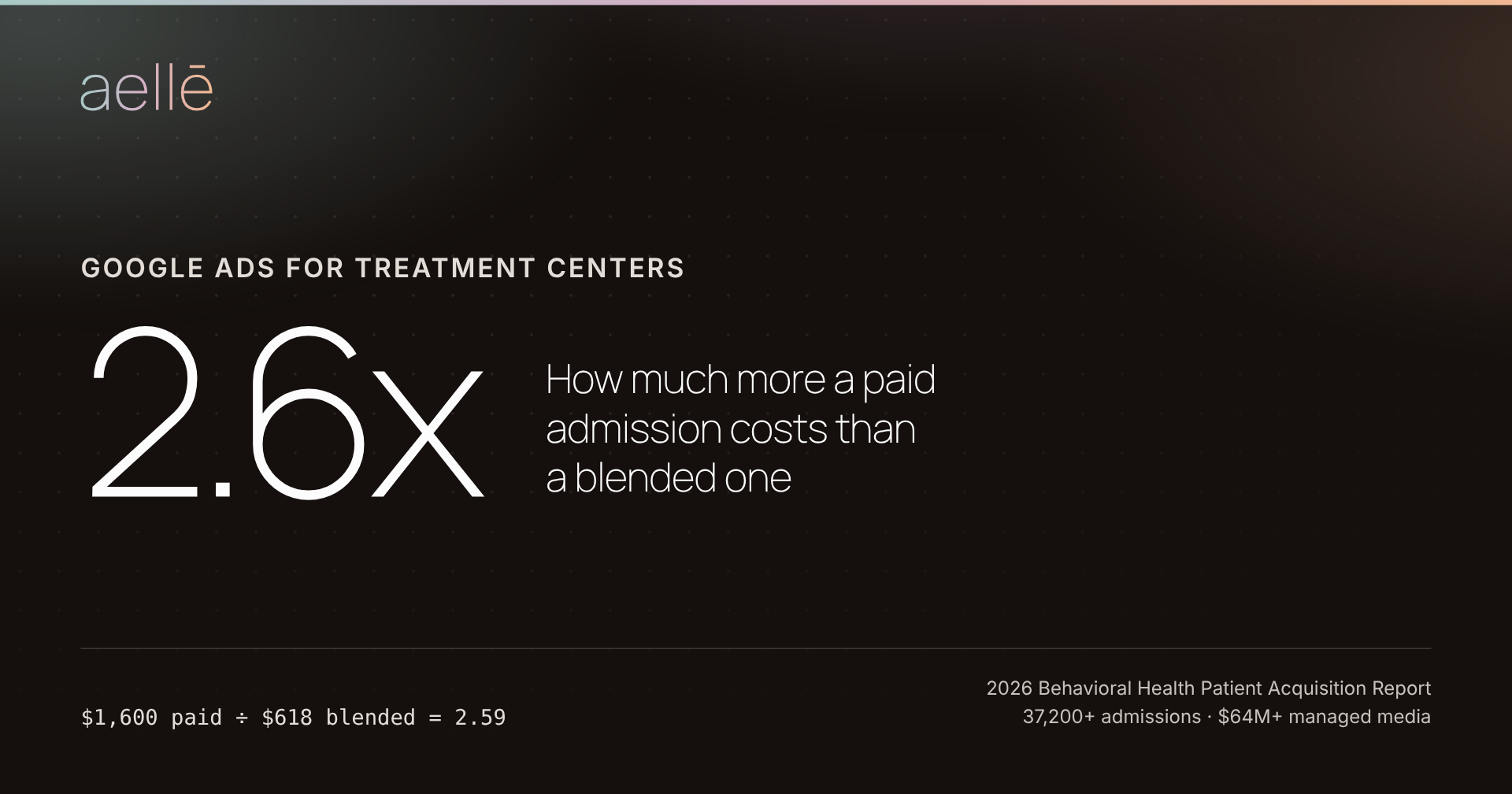
Across our own portfolio the blended cost per admission is $618. Paid media alone is $1,600. Running Google Ads well does not move that second figure far, because the auction sets it. What execution moves is how many admissions the same money buys.
Key takeaways
Six figures, and what each should do to a plan.
| Finding | Figure | What it means for a program |
|---|---|---|
| Cost per admission, paid media only | $1,600 | What advertising costs once admissions rather than leads are the denominator |
| Cost per admission, blended | $618 | Every other channel is subsidising the paid number |
| Paid against blended | 2.6 times | An admission bought through advertising costs 2.6 times the blended rate |
| Arithmetic ceiling on paid share | 39% | 618 divided by 1,600 is 0.386, so paid cannot be most of a healthy census |
| Lifetime average per admission | $1,720 | Eight year average, the number a paid admission has to clear |
| Speed to census | Same month | No other channel on the table does this |
Those figures come from our own portfolio, 37,200+ tracked admissions and $64M+ in managed Google and Meta media since 2018, with definitions in the 2026 Behavioral Health Patient Acquisition Report. The channel split below is from five programs measured between 16 March and 11 September 2026.
In this article
- Why Google Ads is the fastest and the most expensive channel you will buy
- How to structure a Google Ads account for a treatment center
- Which keyword intent tiers actually produce admissions
- What belongs on a negative keyword list for addiction treatment
- Why cost per lead is the wrong number to manage
- How to track conversions that count admissions rather than form fills
- Which bid strategy to run and when to change it
- Five things to run this week
- Questions operators ask
Why Google Ads is the fastest and the most expensive channel you will buy
Because speed and price travel together. Google Ads reaches people already searching for what you provide, at the hour they decided to act, the week you fund it. Referral and local search both take quarters to move, and neither answers a bed count that fell last Tuesday.
| Channel | Admissions | Share |
|---|---|---|
| Paid search and social | 307 | 47.7% |
| Referral partners | 109 | 17.0% |
| Organic search | 82 | 12.8% |
| Direct or untagged | 29 | 4.5% |
| AI labeled, source unverified | 116 | 18.0% |
| Total | 643 | 100% |
That sample's paid figure includes paid social, which this article does not cover. Read the 47.7 percent against the ceiling instead. If paid media costs $1,600 an admission and your blended figure is $618, paid can account for at most 39 percent of admissions, because 618 divided by 1,600 is 0.386. That is forced by the two cost figures rather than surveyed, and a program at 47.7 percent is above the line.
Against the eight year lifetime average of $1,720 per admission, a $1,600 paid admission clears narrowly. So the work is not escaping $1,600. It is making every dollar inside it buy an admission.
How to structure a Google Ads account for a treatment center
One campaign per decision you make. Budget, bids, geography and schedule are set at campaign level, so anything you want to control separately needs its own campaign.
Google requires LegitScript certification to advertise addiction treatment services, and an uncertified account cannot run these campaigns. Treat it as a prerequisite to begin before the build rather than a step inside it.
Segment by level of care
Detox, residential, partial hospitalization and outpatient carry different volumes and close rates. Separate campaigns let you fund the beds you actually have open, a decision one mixed campaign hands to the auction.
Segment brand from everything else
Searches for your program name convert at a rate nothing else matches, and folding them into a general campaign flatters the account while hiding whether the rest works. Give brand its own small budget.
Segment geography by what you can admit
Set location targeting to presence rather than presence or interest, so you pay for people in the places you serve instead of people reading about them. Travel admissions get their own campaign.
Keep ad groups tight and landing pages matched
One theme per ad group, a handful of close keywords, and a landing page naming the level of care the keyword asked for. A detox search landing on a general program page is a second decision the family did not need.
Schedule to when intake answers
Pull your answered call data by hour before setting an ad schedule. Spend that runs when nobody picks up is the most avoidable waste in these accounts, and it hides in overnight hours nobody reviews.
Which keyword intent tiers actually produce admissions
Three tiers, one of which converts. Sorting keywords by intent rather than volume separates an account that produces admissions from one that produces traffic reports.
| Tier | Query shape | How to treat it |
|---|---|---|
| Immediate intent | Level of care plus place, insurance plus level of care, program names | Fund first, exact and phrase match, dedicated landing pages |
| Decision intent | How to get someone into treatment, what a program costs, what to expect | Fund second, expect longer paths, measure on admissions not form fills |
| Information intent | Symptoms, definitions, statistics, withdrawal timelines | Do not buy. Answer it in content and let organic carry it |
Immediate intent is where the $1,600 is earned or wasted. Volume is small, competition is heaviest, and the close rate is the account's highest. Fund it until you stop gaining impression share, before anything else.
Decision intent is the tier most programs over fund or abandon. A family searching how to get a brother into treatment is an admission in two weeks rather than today, so it looks weak in any report crediting same session conversions only. Cap it and judge it on admissions six weeks later.
Information intent is the tier to stop buying. It converts at a rate that makes the cheaper click irrelevant.
What belongs on a negative keyword list for addiction treatment
Four families of waste, reviewed weekly. These accounts leak more budget to irrelevant matching than almost any vertical, because the language of the field overlaps with employment, unrelated medicine and research.
- Employment and training. Jobs, careers, salary, licensure, continuing education, degree programs. None of it becomes an admission, and it is usually the largest block of wasted spend.
- Unrelated modalities. Physical therapy, cardiac rehabilitation, stroke recovery, property restoration, animal rescue. The word rehab does a lot of unrelated work in English.
- Coverage you cannot accept. If a public plan or free pathway is not something you can admit on, its name belongs on the list, paired with a page pointing those families somewhere real.
- Research and reference intent. Statistics, PDF, scholarly, forum terms, and near me phrasings for cities you do not serve.
This is a standing weekly job rather than a one off build. Open the search terms report for the last seven days, sort by cost, and read every term that spent money without an inquiry. Geography negatives go at campaign level, the rest at account level.
Why cost per lead is the wrong number to manage
Because identical lead costs hide opposite outcomes. Cost per lead is the metric every dashboard reports and the one that tells you least, because it stops measuring exactly where the money starts mattering.
| Hypothetical program | Cost per lead | Lead to admission rate | Cost per admission |
|---|---|---|---|
| Program A | $200 | 12% | $1,667 |
| Program B | $200 | 2% | $10,000 |
Those inputs are hypothetical and chosen to be clean. The spread is not. A six times difference in cost per admission between two programs reporting an identical cost per lead is ordinary here, and all of it sits downstream of the ad account.
Which means the highest return work on a treatment center's paid search is often not in the paid search. Before touching bids, measure how long it takes to answer an inbound inquiry, because response time inside the first five minutes moves conversion more than any keyword change. Lifting a lead to admission rate from 2 percent to 4 percent halves cost per admission without changing a bid, and that is conversion rate optimization for addiction treatment in practice.
So stop reporting cost per lead as a headline. Report cost per admission by campaign, accepting a full admission cycle before it means anything. More on how the two relate is in our note on cost per lead in behavioral health.
How to track conversions that count admissions rather than form fills
Send the admission back to Google. Until the platform knows which clicks became admissions, bidding optimises toward the only outcome you reported, usually a form submission, and gets very good at buying those from people who never admit.
Define the conversion actions honestly
Track form submissions, calls past a duration threshold, qualified inquiries and admissions as four separate actions, then mark exactly one as primary for bidding. An account with six primary conversions is one where bidding cannot tell what success is.
Capture the click identifier at the inquiry
Store the Google click identifier on the inquiry record the moment it is created, as a hidden form field and as a parameter passed to call tracking. This step makes everything else possible and is the one most commonly missing.
Write the admission back as an offline conversion
When a family admits, upload the stored click identifier with the admission as the conversion and a value attached. Send the identifier and value only. No clinical or identifying detail goes to an advertising platform, which keeps the flow HIPAA compliant by design.
Reconcile against the census, monthly
Compare what the ad platform reports against the admissions record every month and treat the gap as the finding. If the two cannot be reconciled, the account runs on a number nobody can verify. Our attribution platform exists because most programs lack that reconciliation.
Which bid strategy to run and when to change it
Manual or capped first, automated later. The order matters more than the choice, because automated bidding learns from the data you give it, and most treatment center accounts cannot feed it anything worth learning from on day one.
Start on manual bidding, or maximize clicks with a firm bid cap, while you build the offline conversion feed above. You are buying data deliberately there and should expect a poor cost per admission.
Move to a target cost per action once the campaign produces enough admissions monthly for the system to learn from. Set the target from your own economics, working back from the $1,720 lifetime average rather than from the platform recommendation.
Avoid maximize conversions with no target, which spends the full budget toward whichever conversion is easiest to produce. Give any change two to four weeks, and never change bidding and landing pages together.
Five things to run this week
None of these need new software or a budget increase.
1. Read ninety days of search terms by cost
Open the search terms report, set the window to ninety days, sort by spend, and read down until the terms stop being relevant. Add negatives for all four families and note the spend you just stopped.
2. Cut your primary conversions to one
Count the conversion actions marked primary. If it is more than one, keep the action closest to an admission that still fires often enough to be useful and demote the rest, before any bidding change.
3. Get the click identifier into your CRM
Add a hidden field to every inbound form that captures the Google click identifier and writes it to the inquiry record. If someone else manages your forms, this is the highest value ticket you file this quarter.
4. Compute lead to admission rate by campaign
Take last quarter's inquiries by campaign from the ad platform and last quarter's admissions by source from the admissions record, and divide. The number will be crude and still beat the dashboard.
5. Check answered call rate by hour
Pull a month of inbound call data and find the hours where calls were placed and not answered. Either staff those hours or stop advertising in them. Doing neither is expensive.
Run those five and you will know your own cost per admission. We would check the primary conversion count first, then answered call rate by hour, because the first takes a minute and the second holds the most recoverable admissions.
What we do day to day on paid search is on the Google Ads page and the services page, and published results are in our case studies. Or run the five steps yourself. We would rather you knew your own numbers.
Questions operators ask
How much do Google Ads cost per admission for a treatment center?
Across our portfolio of 37,200+ tracked admissions and $64M+ in managed media since 2018, paid media costs $1,600 per admission against a blended cost of $618. A paid admission therefore costs 2.6 times the blended rate, and against an eight year lifetime average of $1,720 it clears narrowly.
What share of admissions should come from Google Ads?
At most 39 percent, as an arithmetic ceiling rather than a recommendation. If paid media costs $1,600 an admission and the blended figure is $618, paid can account for no more than 0.386 of admissions, because 618 divided by 1,600 is 0.386. In a five program sample of 643 admissions, paid search and social produced 47.7 percent, above that line.
Do I need LegitScript certification to run Google Ads for addiction treatment?
Google requires LegitScript certification to advertise addiction treatment services, and an uncertified account cannot run these campaigns. Treat it as a prerequisite to begin before building campaigns, and confirm current requirements with both parties directly.
How do I increase PPC conversions for a rehab center?
Work downstream of the click first. Two programs paying an identical cost per lead can differ severalfold in cost per admission on lead to admission rate alone, so answering inquiries inside five minutes, cutting primary conversions to one, and feeding admissions back as offline conversions move the number further than ad copy does.
Why are my Google Ads producing leads but not admissions?
Usually because the account is optimising toward form fills. If the only conversion the platform can see is a form submission, bidding gets very good at buying those from people who do not admit. Store the Google click identifier on every inquiry and upload the admission back as an offline conversion. Slow inquiry response is the next cause to check.
Which bid strategy works best for addiction treatment Google Ads?
Manual bidding or maximize clicks with a firm bid cap while you build an admission level conversion feed, then a target cost per action once the campaign produces enough admissions monthly to learn from. Set the target from your own admission economics, and avoid maximize conversions with no target.