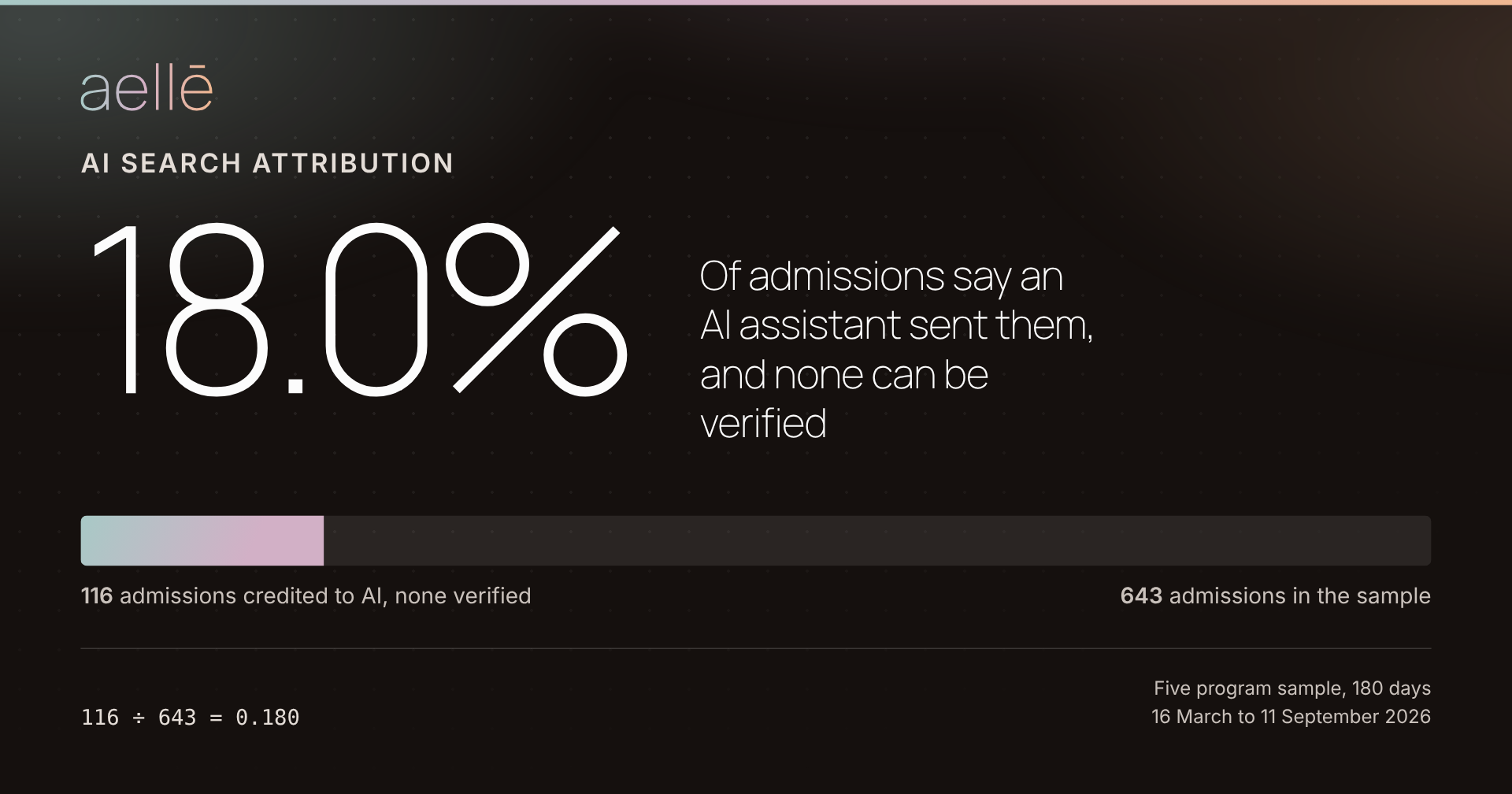
AI search attribution failed on 116 admissions in a five program sample of 643, eighteen percent of the total. Each carried an AI assistant label that no tracking parameter and no intake record could confirm, so we publish them as unverified rather than as AI acquisitions.
That row is the article. Not how to get an assistant to recommend your program, but what to do with a number large enough to move a budget and impossible to prove.
Key takeaways
Five figures, and what each one should do to a plan.
| Finding | Figure | What it means for a program |
|---|---|---|
| Admissions carrying an AI label | 116 of 643, 18.0% | Second largest line in the sample, behind paid media only |
| Those admissions we could verify | None | No parameter and no record confirmed any of them |
| Search demand on this topic | 393 impressions, 65 queries | Zero clicks, so the interest is visible and the traffic is not |
| Growth on assistant citation queries | Up 7,100% | 260 searches a month now, from almost nothing |
| What closes the gap | A parameter, a question, a reconciliation | One quarter of work, no new software required |
Those figures come from our own portfolio, 37,200+ tracked admissions and $64M+ in managed Google and Meta media since 2018, defined in the 2026 Behavioral Health Patient Acquisition Report. The channel distribution is five programs measured between 16 March and 11 September 2026, and the search figures are from Google Search Console and Google Ads Keyword Planner.
In this article
- What the AI search attribution gap actually is
- Why 116 admissions are published as unverified rather than as AI
- Why AI referrals break the tracking you already have
- Why both common responses to that number are wrong
- Why intake is the instrument and analytics is not
- What would make AI search attribution verifiable
- How to close the gap inside one quarter
- What this measurement will still not tell you
- Questions operators ask
What the AI search attribution gap actually is
Admissions that claim an assistant, unprovably. The gap is the distance between what families tell intake and what any system you own can confirm.
Here is the full sample.
| Channel | Admissions | Share |
|---|---|---|
| Paid search and social | 307 | 47.7% |
| Referral partners | 109 | 17.0% |
| Organic search | 82 | 12.8% |
| Direct or untagged | 29 | 4.5% |
| AI labeled, source unverified | 116 | 18.0% |
| Total | 643 | 100% |
Four of those rows can be checked. Paid has a click identifier, referral has a person who can be called, organic has a query and a landing page, and direct is an honest residual.
The fifth has none of that. Somebody arrived, intake wrote down that an AI assistant pointed them here, and the trail ends. At eighteen percent it is the second largest line on the table. A number that size on a foundation that thin is a governance problem.
The same gap shows in the search data. Over 16 months this site collected 393 impressions across 65 distinct queries about AI search and answer engines, and zero clicks. Keyword Planner puts answer engine optimization at 2,400 a month, up 50 percent, and how to get cited by an assistant at 260 a month, up 7,100 percent. It is the only cluster in this market where Search Console and Keyword Planner agree.
Why 116 admissions are published as unverified rather than as AI
Because assigning them invents a number. We hold a label and no evidence, and a label is not a channel.
Eighteen percent of admissions from AI assistants is the most marketable sentence available, and the families saying it have no reason to lie. But a report at intake is not evidence of mechanism. Four different journeys produce those same words.
- They asked an assistant for options, it named the program, they came. The only version we could claim.
- They asked an assistant generally, got no names, then found you through organic or paid. It shaped the decision and made no referral.
- They saw an AI generated summary above a results page and remembered that as the assistant. The click beneath it was organic.
- They already had your name from a clinician, checked it with an assistant, and reported the last thing they touched.
Four truths about what to fund, one set of words at intake. Publishing the row as AI acquisitions asserts the first reading across all 116 cases. So it says unverified. The volume is real, the attribution is not, and the measurement is what is broken.
Why AI referrals break the tracking you already have
Four failures, none fixable in analytics. Most tracking assumes a visitor arrives carrying a record of where they came from. Assistants break that in four places.
The referrer is stripped or never set
Follow a link out of an assistant and the browser may send no referrer at all. Your analytics tool has one job at that moment, reading where the visit came from, and it is handed a blank.
The person reads the answer and then searches your name
An assistant names three programs. The family clicks nothing, types your brand name, and arrives through branded search. Every system you own credits organic, correctly about the session and wrongly about the cause. The same borrowed credit distorts the organic row in reverse.
The conversation and the call happen on different devices
Someone researches on a laptop in the evening and calls from a phone the next morning. No identifier connects those events, and two people in one family often do the research and the call.
The assistant answers and nobody clicks anything
The useful case increasingly produces no visit at all. The assistant describes your levels of care, location and insurance acceptance, the family decides, and your first contact is a call from a number you have never seen.
Why both common responses to that number are wrong
One hides it, one inflates it. Everybody in this category has picked one, and both cost an operator money.
The first is to leave the row out. Those admissions get folded into direct, or into a bucket nobody reads, and the report balances to 100 percent. That is the common choice and the expensive one. Eighteen percent of census is being produced by something, and a program that cannot see it cannot decide whether to protect it or grow it.
The second is to publish the row as a win. It becomes AI driven admissions, it gets a slide, and somebody signs a retainer on a figure nobody tested. When the operator tries to verify it and finds the agency cannot, the credibility loss reaches every other number in the report.
The honest handling is boring. Report the row as unverified, say what it is and is not, then fix the instrument so next year's table does not need the word. That discipline is what makes a cost per admission figure worth anything.
Why intake is the instrument and analytics is not
Because only a person knows it. No configuration of an analytics tool measures this, since in two of those four cases the measurable event never happens, so the last reliable record of how a family found you is what they say on the phone.
For every other channel on that table the dashboard is good enough. For this one it is structurally blind.
Treating it as an instrument has consequences. Every coordinator asks the same question in the same words. The field is required, because an optional one samples whoever felt like filling it in. And it sits in the same record as the admission, because a measurement that cannot be joined to an outcome is a survey, not attribution.
Response time decides whether those inquiries convert at all, and the five minute rule sits upstream of everything measured here.
What would make AI search attribution verifiable
Three changes, all three required. One or two of them produces a different incomplete number rather than a verified one.
A dedicated tracking parameter on every URL you control that an assistant might surface. Not a general campaign tag. One reserved parameter marking any link placed where an assistant could retrieve it, across the site, directory listings and profiles. It catches only the minority who click, and that is the only hard evidence available.
An intake question asked on every first call, with a required field recording the answer. Same wording every time, required rather than optional, stored on the inquiry record that later carries the admission. This catches what the parameter cannot see.
Reconciliation of that field against census rather than against a dashboard. Monthly, comparing the field on admitted records against the admissions the program took. If the two disagree, the field is being skipped. Reconciling against an analytics report proves nothing, because that report cannot see this channel.
Run all three for a quarter and the unverified row splits into three defensible pieces. A parameter plus a matching intake answer is confirmed. An answer with no parameter is claimed. An admission with neither stays unverified. Our attribution platform performs that join automatically, and it works in a spreadsheet when both inputs are clean.
Being retrieved and cited by assistants is a separate problem, and measuring the channel honestly is what tells you whether that work pays.
How to close the gap inside one quarter
Four steps, none needing new software or budget approval.
1. Add the intake question with fixed wording
One script line for every coordinator, asked before the clinical questions. Use these words exactly.
"Before I take your details, how did you first hear about our program, and if something online pointed you to us, which website or app was it?"
Two parts, deliberately. The first catches people and organisations. The second separates an assistant from a search engine, because a caller who came through one will name it when prompted.
2. Put the answer in the admissions record, not in notes
One required single select field on the inquiry record, inside whichever system of record produces your census report, on the same record that later carries the admission. Not in call notes, not in analytics. Options are referral from a person or organisation, search engine, AI assistant, social media, saw an advertisement, already knew of us, and other. Add a required text box for the caller's own words. It is ordinary operational data under your existing HIPAA compliant processes.
3. Reserve one tracking parameter and apply it everywhere you control
Pick one parameter value, document it, and apply it to links you place on any surface an assistant might read. Keep the list of where it is applied, because the list is what you maintain. Treat every hit as evidence rather than volume.
4. Reconcile the field against census monthly and report three numbers
Each month pull admitted records, check the field is populated, and report confirmed, claimed and unverified as three lines. Never collapse them. The unverified line falling quarter over quarter is the proof the instrument works.
What this measurement will still not tell you
It cannot produce a true share. Run properly for a year, this method tells you what families report and what a parameter caught, and the two together are a floor, not the channel's real size.
We are not going to publish a figure for how much of that eighteen percent is genuinely assistant driven, because we do not know, and modelling it would be the same error as claiming it. The value here is that the number is reported as unknown.
It will not tell you whether an assistant described you accurately, or named you in conversations that went nowhere. Those are visibility questions.
And it does not change the arithmetic underneath the plan. Blended cost per admission is $618 and paid only is $1,600, so paid costs 2.6 times blended and accounts for at most 39 percent of admissions. Whatever the AI row turns out to be, it sits inside the 61 percent that the paid ceiling leaves to every other channel.
Questions operators ask
Can AI referrals be tracked at all?
Partially, and not through analytics alone. Assistants frequently strip or never set referrer data, families read an answer and then search the brand name, research and call happen on different devices, and assistants increasingly answer with no click at all. A parameter catches the clicks and a required intake question catches the rest.
How much of a treatment center's admissions come from AI search?
Nobody currently knows, including us. In a five program sample of 643 admissions, 116 carried an AI assistant label, 18.0 percent, and none could be verified against a tracking parameter or an intake record. We publish no figure for the real share, because any such figure would be invented.
Why does traffic from ChatGPT show up as direct in analytics?
Because no referrer arrives with the visit. Your analytics tool reads where a session came from, and when that value is missing the session lands in direct traffic. No configuration fixes it, which is why the intake record becomes the instrument.
What exactly should an intake coordinator ask?
One fixed line before the clinical questions. "Before I take your details, how did you first hear about our program, and if something online pointed you to us, which website or app was it?" The second half distinguishes an assistant from a search engine, and the wording should not vary.
Does asking how someone heard about us create a compliance problem?
No, when it is handled like the rest of your intake data. The question captures a marketing source and no clinical information, and it belongs inside the HIPAA compliant processes you already run on inquiry records. The usual mistake is keeping the answer where it is governed by nothing.
Does better measurement help us get recommended by assistants?
Not directly, and it tells you whether the work aimed at that is paying. Getting retrieved and cited is a separate problem. Without measurement, any spend on assistant visibility is unaccountable.
What we would look at first on your account
Whether the intake field exists, and whether it is required. Those two answers decide whether you have any instrument for eighteen percent of census.
What we do day to day is on the services page, and results we have published are in our case studies.
Or run the four steps above and keep the answer. We would rather you knew your own numbers than took ours.