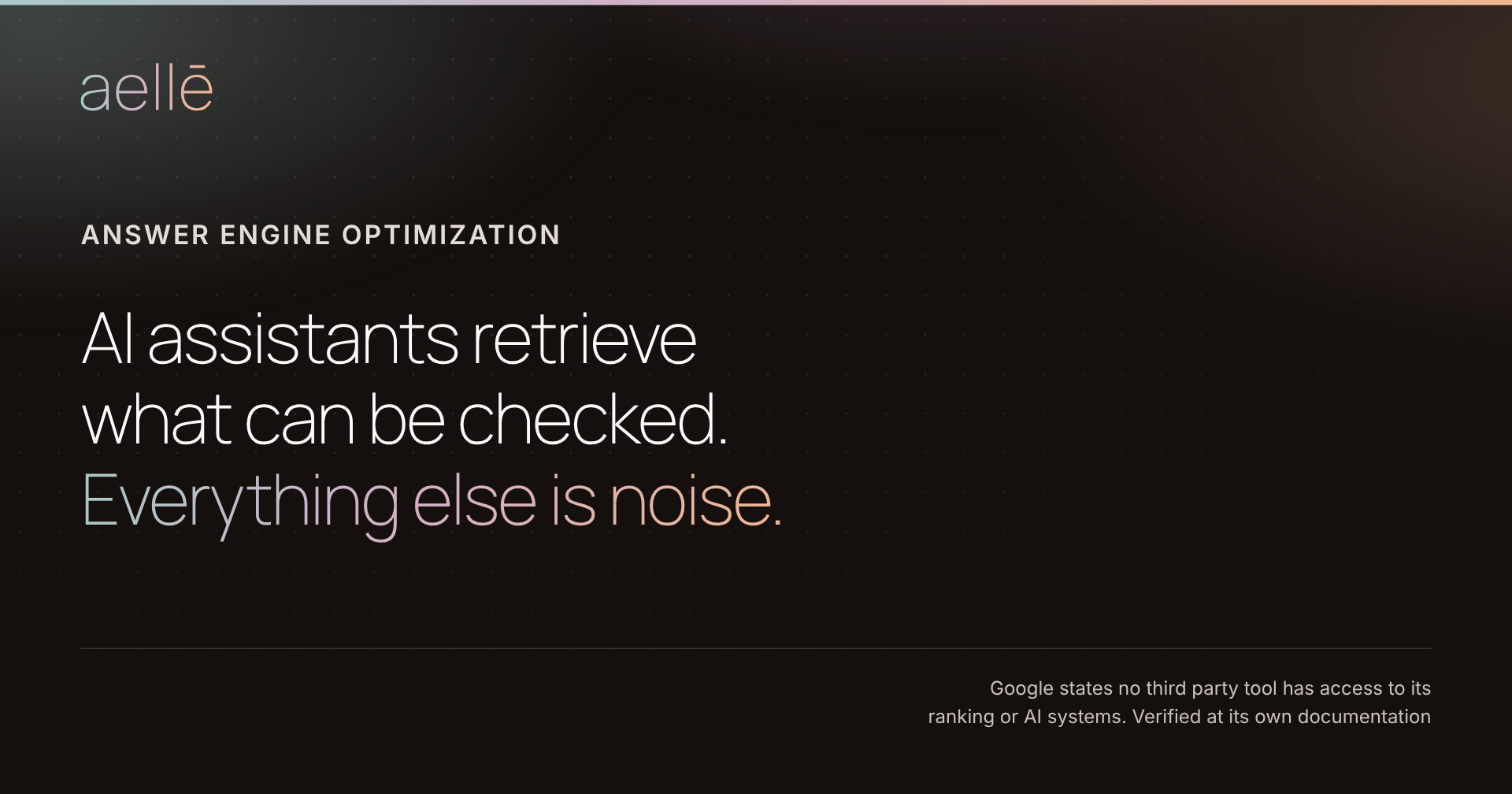
Answer engine optimization rewards one thing, being the only source of a specific checkable claim.
Everything else under that label is either ordinary search work with a new name on the invoice or a promise nobody can keep. Measuring what assistants send you is a separate problem, and a separate article.
Key takeaways
Six findings, and what each one should do to a plan.
| Finding | Figure | What it means for a program |
|---|---|---|
| Demand on this topic | 2,400 a month, up 50% | Low competition against a top of page bid of $7.02 to $21.91 |
| Growth on citation queries | Up 7,100% | 260 a month now asking how to get cited by an assistant |
| This site's own position | 393 impressions, zero clicks | 65 queries over 16 months, interest visible and traffic absent |
| Special markup Google requires | None | Its own guidance says no schema is needed for its AI features |
| FAQ rich result in Google Search | Retired 7 May 2026 | The markup still describes the page, the rich result is gone |
| What actually earns a citation | A specific checkable claim | Specificity and sourcing, not keyword density or length |
Portfolio figures come from our own book, 37,200+ tracked admissions and $64M+ in managed Google and Meta media since 2018, defined in the 2026 Behavioral Health Patient Acquisition Report. Search figures are from Google Search Console and Google Ads Keyword Planner, and platform statements from Google's and OpenAI's own documentation.
In this article
- Why answer engine optimization is not a new discipline
- Why assistants prefer figures, dates and named methods
- How to structure an answer so it can be lifted whole
- What schema, llms.txt and crawler controls actually do
- What families and clinicians actually ask an assistant
- Why a citation without a click is still worth something
- Five things to publish this quarter
- Questions operators ask
Why answer engine optimization is not a new discipline
Because retrieval still rewards sourcing. Google has published guidance on optimising for generative AI features, and the substance of it is that those features run on the same ranking and quality systems as the rest of Search. Four statements in it are worth reading first.
- Structured data is not required and there is no special schema markup to add.
- There is no requirement to break content into tiny pieces.
- A page must be indexed and eligible to be shown in Search with a snippet to appear in those features at all.
- Google cautions against tools claiming special access to its systems.
What changed is the unit of competition. An assistant reads several documents and returns one paragraph with a few links beneath it, so your page is no longer competing for a click. It is competing to be the sentence, which is the contest a journalist runs when choosing whose figure to quote, and it has always been won by whoever published something specific enough to attribute.
Why assistants prefer figures, dates and named methods
Because a specific claim is retrievable. A model assembling an answer needs sentences it can stand behind and attribute, and a sentence carrying a number, a period and a stated limit is one of those.
Compare two true statements. The first is that most treatment centers see strong results from digital marketing. The second is that paid media produced 307 of 643 admissions across five programs measured between 16 March and 11 September 2026, which is 47.7 percent. Both are defensible, and only one can be quoted, attributed and checked. The first is not weak because it is vague. It is unusable because there is nothing in it to lift.
No provider publishes its retrieval function, so the preference for specificity is an inference from how extraction works rather than a published rule.
Why a page that hedges everything is unciteable
Clinical caution, legal review and the real variability of outcomes all push a treatment center's language toward commitments nobody can be held to. The result is a page where every sentence is qualified, none carries a number, and the only concrete fact is a phone number. Such a page can rank and never be quoted. Ranking needs relevance. Quoting needs a claim.
Our own practice is the one example we can speak to honestly. We publish an annual report where every figure is defined and the limit sits beside the number. Blended cost per admission is $618 and paid only is $1,600, so paid costs 2.6 times blended and can account for at most 39 percent of admissions, because 618 divided by 1,600 is 0.386. That sentence carries its own proof. We claim nothing about what publishing it has done for our retrieval, because we cannot measure it.
How to structure an answer so it can be lifted whole
Claim first, then the support. An assistant lifts paragraphs rather than pages, so the test is whether any paragraph on your site survives being removed from the page around it. Four parts, in this order, make one that does.
- The claim. One sentence, stated flatly, no preamble. If the heading asks a question, this sentence answers it in the first handful of words.
- The figure. The number, the sample it came from, and the period it covers. A number with no denominator is a slogan.
- The source. Named, so the paragraph is attributable without the reader leaving it.
- The limit. What the figure does not establish. The part everybody removes, and the part that makes the rest credible.
Self containment is not fragmentation, which matters because much of the advice circulating here amounts to shredding a page. A long paragraph can still be liftable, while a page of disconnected fragments is worse for the family and no better for the model.
Two consequences. Put the answer in prose rather than only in a table or an image, because text is what gets quoted. And write the heading as the question somebody would say, then answer it underneath, because the pair is the unit.
What schema, llms.txt and crawler controls actually do
Less than vendors claim, still something. This is the awkward part for anybody selling markup as an answer engine strategy.
| Item | What the documentation says | What to do |
|---|---|---|
| FAQPage markup | FAQ rich result retired from Google Search 7 May 2026, its documentation removed 15 June 2026 | Keep accurate markup, expect no rich result |
| Schema for AI features | Not required, no special markup, should match the visible text | Do not pay for it as an AI tactic |
| llms.txt | A proposal open for community input, and Google Search does not use it | Optional, useful to write, claims nothing |
| Snippet controls | Four directives limit what Google shows from a page, and changes take days to months | Audit first, they can hide you |
| Search crawler access | Sites opted out of OpenAI's search crawler are not shown in ChatGPT search answers | Check robots.txt today |
Headings do more work here than markup, because a question with its answer immediately beneath creates the liftable unit.
The llms.txt proposal describes a markdown file giving a model brief background and links to more detailed markdown, since context windows are too small for whole websites. The proposal calls itself open for community input, the repository hosts it as an informal overview, and nothing in it records any provider committing to read the file. The expanded llms-full.txt most sites publish is a community convention rather than part of the proposal. We maintain both here, not from a ranking expectation but because writing them forces a decision about which pages represent the business and what each claims.
Access is the part that genuinely matters. Google lists nosnippet, data-nosnippet, max-snippet and noindex as the controls limiting what is shown from your pages, and warns changes can take days to months to apply. A program that applied those years ago to keep text out of search results has also removed itself from the text an assistant can quote. OpenAI documents one crawler for search and a separate one for training, controlled independently, so a site can allow the first and disallow the second. Checking all of that takes minutes and outranks everything else here.
What families and clinicians actually ask an assistant
Questions your pages do not answer. The gap between what gets asked and what a program publishes is wider here than anywhere else in behavioral health marketing, and it is almost entirely fixable. These are operational questions.
- Do they take my plan, in network or out of network.
- How long is the wait for a bed right now.
- Do they treat someone with both an eating disorder and alcohol use.
- Is detox on site, or somewhere else first.
- Can a parent visit in the first week.
- What does it cost without insurance.
- Are they licensed and accredited, and by which body.
- Can my patient continue a prescription in the program.
Read your own admissions page against that list. Insurance becomes a sentence about working with most major providers. Wait time is absent. Cost becomes an invitation to verify benefits. Accreditation appears as a footer logo, and an image cannot be quoted.
Most of those questions are answerable and most are not clinical. A page naming the plan networks you participate in, with a date, stating whether detox is on site, giving the current admission window, naming the accreditation and its granting body, and publishing a self pay figure, answers more real questions than anything else you publish. It is also the page your local profiles should point at. None of it discloses anything about a person, so it sits inside HIPAA compliant practice.
Why a citation without a click is still worth something
The family arrives already decided. An assistant describing your levels of care, location and insurance acceptance accurately has done work your website would otherwise do, and first contact becomes a phone call rather than a session in analytics.
Google says sites appearing in its AI features are counted in overall search traffic in Search Console under the Web search type, and describes those clicks as higher quality because users are more likely to spend time on the site. Read honestly, that says two things at once. The clicks you get are better. There are fewer of them. Three measures hold up.
- Whether an assistant names you. Ask the operational questions above, in fixed wording, on a schedule. The only direct read available.
- Whether what it says is accurate. A confident wrong answer about your insurance acceptance costs more than silence, and the published source is the only lever.
- Calls with no prior digital touch. Rising first contacts that arrive already informed signal something upstream is describing you well.
Tracing those calls back to a specific assistant is a separate and harder problem, and the one we wrote up in full in the AI admissions attribution gap. Nothing here measures the channel, only tries to get you into it. Two things sit downstream regardless. Response time decides whether a well informed inquiry becomes an admission, and reconciling what families say against what your systems recorded is what our attribution platform is for.
Five things to publish this quarter
None need new software, and the first is free.
1. Audit your snippet and crawler controls
Open your robots.txt and search your templates for the four snippet directives. If one is suppressing text you want quoted, or if robots.txt blocks the crawler an assistant uses for search rather than for training, you have been invisible by configuration.
2. Put one checkable number on your admissions page
One figure, with its denominator and its period. Current admission window in days, beds at each level of care, people admitted last year. Pick something true you will maintain, and state the limit beside it.
3. Rewrite your questions page as actual questions
Take the eight questions above, in the wording a family would use rather than your clinical documentation, and answer each in the first sentence beneath its heading.
4. Publish the operational answers in prose
Plan networks by name with a date. Detox on site or not. Accreditation and granting body in text rather than as a logo. A self pay figure or an honest range.
5. Record what assistants say about you, monthly
One document, the same questions each month, answers pasted in with the date. Within two quarters you will know whether you are named, whether the description is accurate, and which page it draws from. It is the only visibility report here that is actually yours.
Questions operators ask
What is answer engine optimization?
It is the work of making a page the source an assistant quotes, rather than one of ten links a person chooses between. In practice it is ordinary search quality work with a narrower target, because the assistant returns one paragraph instead of a list.
How do I get cited by ChatGPT?
Publish something specific nobody else publishes, and check you are not blocking the crawler. OpenAI documents a crawler used to surface sites in ChatGPT's search features and states that sites opted out of it will not be shown in ChatGPT search answers, with a robots.txt change taking around 24 hours to register. Beyond access, nobody controls whether an answer cites you.
Does llms.txt help a treatment center get cited?
There is no evidence it does, and Google says its Search systems do not use these files and that creating them will neither help nor hurt Search visibility. The proposal calls itself open for community input rather than a standard, and no provider has published a commitment to read it.
Does FAQPage schema still work?
Not as a rich result. Google's documentation records the FAQ rich result as deprecated, no longer appearing in Google Search from 7 May 2026, with the documentation removed on 15 June 2026. The question and answer structure of the page is what creates a quotable unit.
How do we know whether an assistant is recommending our program?
Ask it the questions families ask, in fixed wording, on a schedule, and record the answers with dates. That tells you whether you are named and whether the description is accurate. It does not tell you how many admissions resulted, which is a measurement problem with its own article.
What nobody can promise you about retrieval
No one controls it. Not us, no vendor, no tool. Google cautions against third party services claiming special access to its systems, and nothing OpenAI publishes supports a guarantee either. Anybody selling a citation, a share of voice figure or a guaranteed place in an AI answer is selling something that does not exist, and the operator pays twice, in fees and in the credibility of every other number in the report.
What is inside your control is narrow. Whether your pages are crawlable and quotable, whether they carry one claim nobody else publishes, and whether they answer what a family actually asks.
What we do day to day is on the services page, and results we have published are in our case studies.
Or run the five steps above and keep the answer. We would rather you knew your own numbers than took ours.